
How I Broke Free from AI Fatigue
Practical Tips to Help You Grow Through Overwhelm

Hello friend,
I know—you’re probably tired of seeing yet another email about AI.
Trust me, I get it.
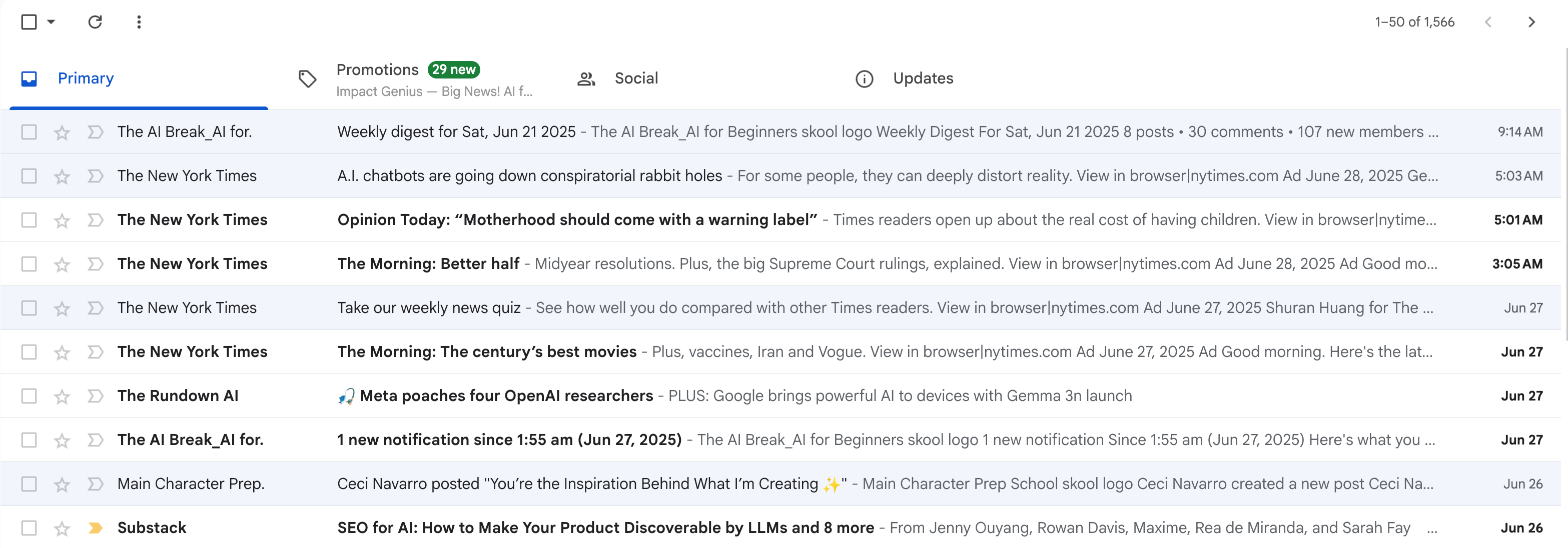
Here’s a screenshot of my inbox: it feels like every other subject line is screaming about AI. 🤯
My social feeds? Buzzing with people showing off the latest tools they’ve mastered.
Every day on the news is telling us how AI is evolving and changing everything.
It’s a lot.
Even though I work with AI and love using AI, I can’t deny it: AI fatigue is real.
It feels like everywhere you turn—education, newspapers, Facebook, X —there’s someone shouting,
“AI will replace your job!”
“AI will write all the books!”
“AI will take over the world!”
I can’t help but wonder: What jobs are actually safe from AI?
If you’ve ever felt this way, you’re not alone.
Sometimes, I just want to shout: “Please.. can we just chill about AI for a moment?”

What Is AI Fatigue? (And Why Does It Happen?)
AI fatigue is the mental and emotional exhaustion that comes from trying to keep up with the flood of AI tools, trends, and expectations.
It’s that persistent feeling of there’s always more I should learn but not enough time, I don’t know where to start, everyone else is ahead of me.
So, why does this happen?
Too much information:
There’s an overwhelming number of tools, acronyms, and trends to sort through. You want to stay updated, but each topic takes time to master.
And instead of diving in, you freeze, overwhelmed by the sheer volume of it all.
Rapid change:
AI evolves so quickly that it feels impossible to stay ahead.
When changes move faster than we can process, our brains naturally tune out — not from laziness, but to protect our mental health.
Fear and comparison:
Headlines about AI taking jobs grab attention, and social media is full of people showing off their expertise with guides and AI-powered creations.
If you’re just starting out, it’s easy to feel like you’re already behind and might never catch up.
How I Learned to Manage AI Fatigue (Without Giving Up on Growth)

Recognizing my AI fatigue was the first step. The second? Finding practical ways to manage it effectively.
Here are few strategies that helped me break free from the overwhelm and get back on track.
1/ Focus on Alignment, Not Abundance
The first thing I did was stop trying to learn everything about AI and instead asked myself: What concepts and skills actually matter for the work I’m doing?
It’s tempting to try to absorb it all—new tools, new technologies, and endless possibilities. But you don’t need to master everything to grow or to be seen as an expert.
Think of AI like a buffet. Just because there are 50 dishes doesn’t mean you need to try them all. I chose to focus on the “dishes” (concepts and developments) that are most relevant to my field and goals, and I let the rest go.
I also recognized where I am an expert and where I’m not—and connected with people who are experts in those areas. Remember, no one can remember everything.
By narrowing my focus to what truly mattered, I free myself from the pressure of keeping up with everything. Now, I can dive deeper into what actually makes a difference for me.
2/ Schedule Your Curiosity and Set “Tech-Free Zones”
One of the biggest shifts I made was setting aside intentional time to study and play with AI—even if it’s only 5 minutes a day. The best way to learn is to try it out.
Instead of overthinking, give yourself space to catch up, explore, and experiment.
Once you get started, you’ll realize it’s not as complex as it seems.
As I shared in last week’s newsletter: everything is figureoutable. If you’re scared to try something new, take it as a sign that you’re growing. And I’m excited for you!
At the same time, I also made sure to carve out “tech-free” time — moments when I worked without any AI tools, notifications, or distractions.
This is where creativity is born.
No matter how advanced AI becomes, it will never think like a human.
❇️ During these “tech-free” hours, I focused on deep thinking, creative problem-solving, and reconnecting with my intuition. It’s like tending a garden: AI is the fertilizer—it helps things grow faster. But without nurturing the soil (your creativity and clarity), no amount of fertilizer will help.
3/ Focus on Our Unique Strengths and Let AI Enhance the Process
Instead of feeling pressured to master everything AI can do, I doubled down on my unique strengths—the skills that make me valuable and irreplaceable in my field.
For example, in the world of product design, AI might help a designer create app demos, but it doesn’t replace the strategic thinking of a product manager—someone who develops the business model and Go-to-Market strategy, thinks about how the product stands out in the market, and ensures it meets customer needs and succeeds in the market.
❇️ When we see AI as a tool rather than a threat, we can leverage AI to handle repetitive or time-consuming tasks, speed up the process. It allows us to take those time to focus on the areas where humans truly shine: connecting with people, developing strategies, and creating meaningful impact.
💭 Final Thoughts
AI is an incredible tool, but it’s just that—a tool.
It’s not a replacement for your creativity, intuition, or humanity.
You don’t need to learn everything all at once. What truly keeps you ahead isn’t mastering every detail—it’s staying open to learning, questioning what you see, and focusing on what aligns with your goals.
When you prioritize what matters, you’ll find that the overwhelm starts to fade, and clarity takes its place.
🧘🏻♀️ So let’s take a deep breath, slow down, and remember:
even 5 mins a day adds up.
You are making progress, even if it doesn’t feel like it yet.
Xoxo,
Kessie 🧚♀️
Fatigue is a mental state… haha great stuff Kessie
Haha, I definitely feel that AI fatigue too, thanks for sharing your experience!